How Steep Can a Driveway Be in Georgia?
As far as we can find, Georgia has no single statewide limit on driveway grade. The county or city usually sets it. In the North Georgia county codes we read, the number for a home driveway is 15 to 17 percent.
Commercial drives run lower, at 8 percent in Dawson and Habersham counties. Fire access roads are held to 10 percent unless the fire code official approves steeper. Some of these numbers cover only the part of the drive inside the right-of-way, so read the table closely.
This is a plain-language summary, not legal advice. Ask your county about your own lot before any work starts.
What does a driveway grade percentage mean?
Percent grade is feet of rise for every 100 feet of run. A 15 percent driveway climbs 15 feet in 100 feet. That is about 1.8 inches per foot, or about 8.5 degrees. A 10 percent grade climbs 10 feet in 100 feet, about 1.2 inches per foot.
Your drive’s grade starts with the ground under it. On our asphalt driveway paving jobs, grading for drainage comes before the stone base or any hot mix.
What do North Georgia county codes say about driveway grade?
Each county writes its rule for a different part of the drive. Here are the numbers we found and what each one covers.
| County | Rule | Where it applies |
|---|---|---|
| Dawson | 15 percent | Residential driveways, within the county right-of-way |
| Dawson | 15 percent finished grade | Common access driveway |
| Floyd | 15 percent | Residential driveways, within the right-of-way |
| Polk | 15 percent | Any driveway accessing a county road |
| Habersham | 17 percent | Residential driveways; this line names no right-of-way limit |
| Habersham | 17 percent, up to 20 percent in extreme conditions with the county engineer’s approval | Common access driveway |
| Dawson and Habersham | 8 percent | Apartment, commercial and industrial driveways |
| Cherokee | 14 percent | Public and private streets in residential subdivisions; a street standard, not a driveway standard |
Dawson and Habersham define a common access driveway the same way. It is the main access to a public street, shared by three to five parcels. If your drive is shared or serves several homes, see our road paving page.
Dawson’s and Floyd’s home driveway numbers are written for the right-of-way. The part of a long drive deep on private land may not be covered. Habersham’s 17 percent line names no right-of-way limit. Its permit section covers driveways on or abutting a county road right-of-way.
Your county may publish no number at all. Its permit office is the one to ask.
Does a house driveway have to meet the fire code’s grade limit?
Usually not. The Georgia edition of the fire code’s Appendix D holds fire apparatus access roads to a 10 percent grade. Steeper grades are allowed as approved by the fire code official. A Georgia city fire marshal’s checklist holds fire access roads to the same 10 percent unless otherwise approved.
A Georgia county fire marshal’s checklist lists one- and two-family dwellings among the exceptions to those access road specifications. So a house driveway is usually outside that rule, but a fire truck still has to get up it. Commercial and multifamily sites are generally inside it. Your local fire marshal can say how it applies to your site.
How should a steep driveway meet the road?
On a state route, Georgia DOT says the driveway grade should generally continue the road’s cross slope. That cross slope should be kept for at least 12 feet past the edge of pavement. Where a road is banked on a curve, the driveway grade may break at the pavement edge. That change must not exceed 0.08 foot per foot, which is 8 percent.
County roads differ. Polk County wants the driveway surface to slope at least 5 percent down and away from the county road’s edge. That slope runs for 6 feet or to the ditch centerline, whichever is less, so water stays off the road. In Dawson and Habersham, grades inside the right-of-way are controlled by the existing shoulder slope or sidewalk elevations.
The road owner’s rules apply at that connection, and we build to them. For the pipe under the drive at the road edge, see the driveway culvert guide.
What makes a steep driveway scrape a car?
A sharp change in grade is what scrapes the underside of a car. It happens where the drive breaks at the road or at the garage. Dawson County’s driveway ordinance names this for special use vehicles. Their underside clearance or break over angle dictates the maximum driveway grade.
Break over angle is how sharp a crest a vehicle can cross before its underside touches. If you own a low car or pull a trailer, tell us when we look at the site.
Why does water matter so much on a steep driveway?
Georgia’s Better Back Roads field manual was written for unpaved roads, not paved drives. It says to avoid steep grades. The figure is under 18 percent north of the fall line and under 10 percent south of it. Northwest Georgia and the mountains sit north of that line.
The Georgia Forestry Commission’s manual was written for forestry roads. It keeps new permanent access roads ideally below 10 percent, with up to 12 percent for short distances. On highly erosive soil, it says to reduce grades.
Neither manual sets a rule for your paved driveway. They still matter because water runs faster down a steep grade. Running water can carve out the edges and wash out sections of a drive. If that has started on yours, see asphalt driveway repair.
Is there a minimum slope for a driveway?
A state asphalt association says yes. Its guidance is to design driveways with a minimum slope of 2 percent, a quarter inch per foot. It says flatter slopes are hard to build and may not prevent water pooling in wet weather.
Can a steep driveway be paved with asphalt?
Yes, though the work changes on a hill. A paving trade magazine says trucks and rollers behave differently above about a 7 to 10 percent grade. That is especially true with a turn. It says crews typically order a more aggressive, stony mix that holds together under the rollers and gives better traction.
The same magazine says a roller going up a hill can spin and tear the asphalt. Going down, it can push it. It says crews often let the mat cool a bit more before rolling. It also says contractors often recommend going thicker than on flat ground, because the wear is higher.
That is general trade guidance, not our spec. Your estimate spells out the thickness, the base work and the square footage for your job.
How do we handle a steep driveway in Northwest Georgia?
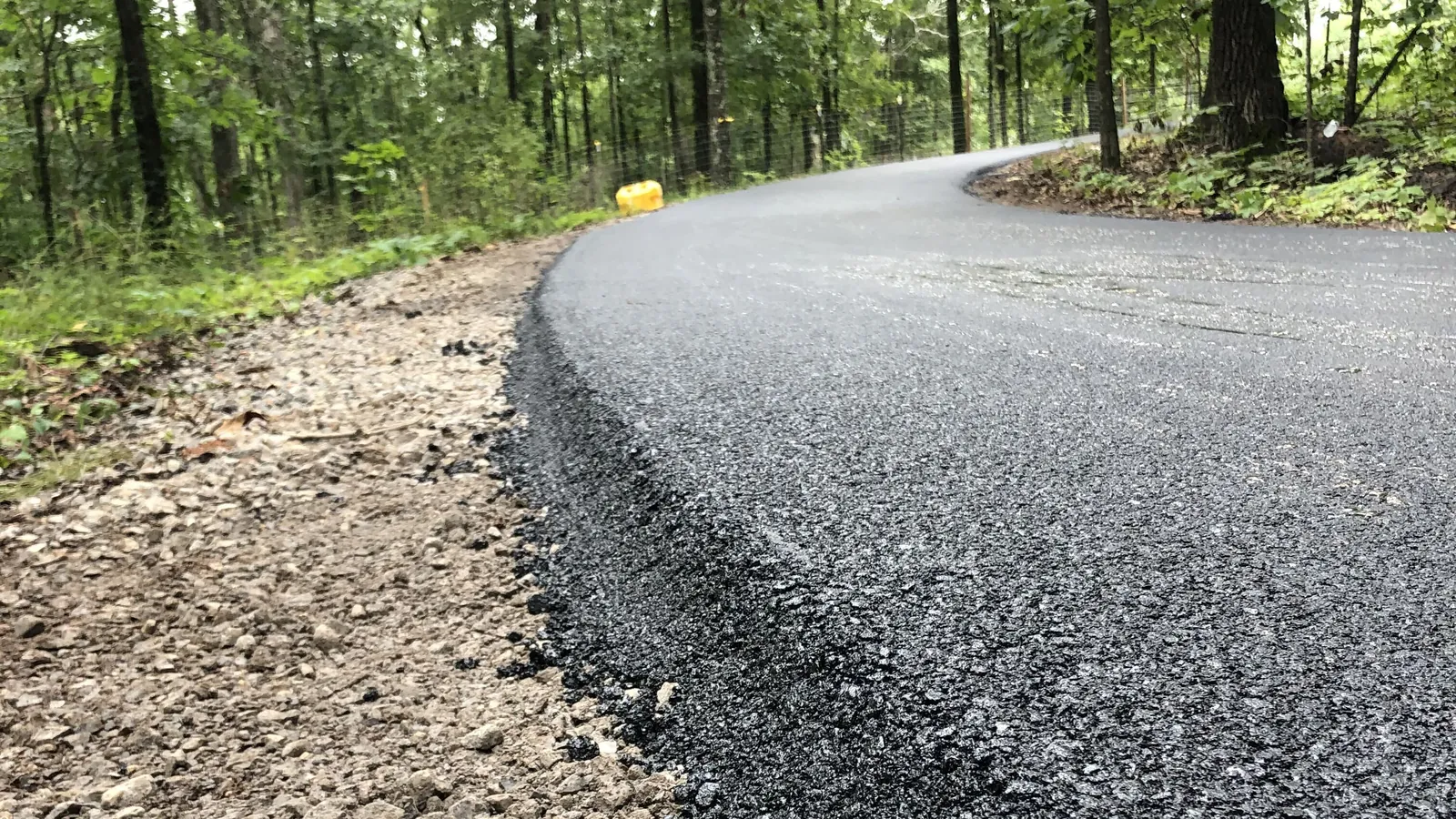
We pave steep driveways and long mountain drives. One kind of job we do is a steep mountain driveway about 1,200 feet long, paved over two days. We grade for drainage and set a drain pipe under the drive where the site needs one. The stone base goes down and gets compacted, then hot mix goes down with our own paver and gets rolled.
If your drive ties into a state route or a county road, the road owner’s rules apply. We build to them. A site that needs engineering or a survey needs those professionals too.
Based in Cartersville, we work Northwest Georgia and the north side of metro Atlanta, with larger paving projects farther out. See what goes into our asphalt driveway paving, then call (706) 844-2123 or request an estimate.