Questions About Asphalt Paving Around Cartersville and Northwest Georgia
These are the questions homeowners, farms and businesses across
Northwest Georgia ask us most: when you can drive on new asphalt, how
pricing works, paving over gravel, thickness, tar and chip and the
paving season. If yours is not here, call and we will answer it.
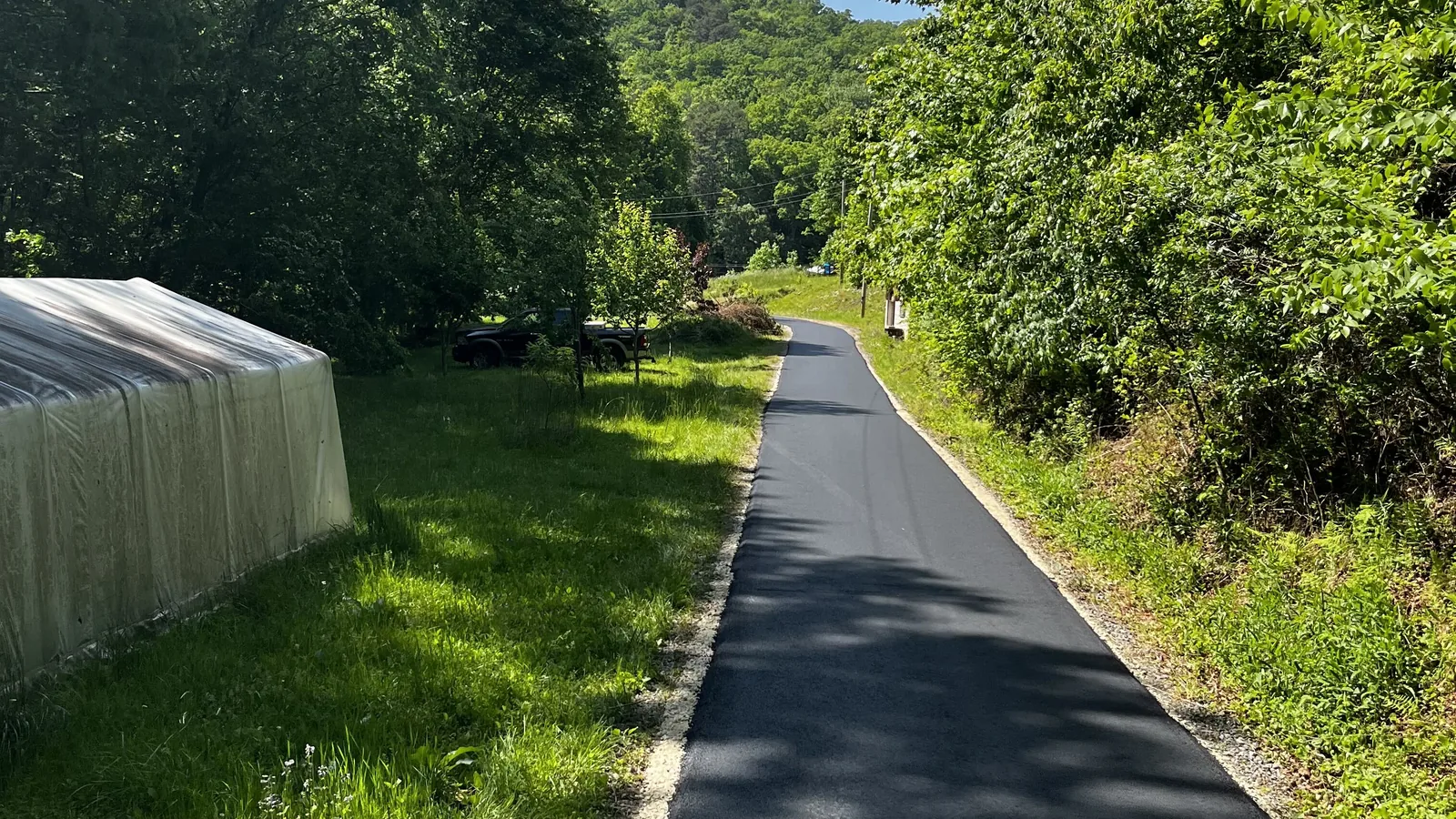
New hot mix can be driven on soon after it is rolled. Asphalt industry guidance still says to wait a few days before normal use. Keep heavy trucks, moving vans and loaded trailers off a fresh mat longer than that. Hot weather keeps new pavement soft longer, so a Georgia summer job needs more time. We tell you what to stay off and for how long before we leave the site.
How does pricing work for asphalt paving?
Every job gets priced off the site itself. The square footage, the grading and the base work the ground needs all move the number. So does the asphalt thickness and how easily equipment can reach the area. Pavement that has to be torn out costs more than paving over a gravel base that is already there. We come out, look at the site and give you an estimate that lists all of it.
What areas do you serve?
We are based in Cartersville and work Northwest Georgia and the north side of metro Atlanta. We like to stay inside about 50 miles. That covers Rome, Acworth, Kennesaw, Marietta, Woodstock, Canton, Dallas, Calhoun, Dalton and Atlanta. Larger paving projects we will take farther out. See the towns we cover or call and ask about yours.
Can you pave over a gravel driveway?
Yes, and a gravel drive is often a good place to start. Some of the stone base is already there. We shape it, add stone where it is thin and compact it. Where the gravel sits on soft ground or holds water, that gets fixed before any hot mix goes down. Paving over gravel is one of the most common jobs we do.
How thick should an asphalt driveway be?
Industry guidance puts a home driveway near 3.5 inches of compacted asphalt over 6 to 8 inches of stone base. That is usually a 2 inch bottom course with a 1.5 inch surface course on top. Heavier vehicles and soft ground call for more. On sound pavement, an asphalt overlay is commonly 1.5 to 2 inches. Your estimate spells out the thickness, the base work and the square footage for your job.
Asphalt or tar and chip for a long driveway?
Hot mix asphalt gives a smooth, sealed surface that takes heavier traffic and is easier to clean. Tar and chip paving sprays liquid asphalt and rolls stone chips into it, for a rougher country road look. Georgia DOT points to surface treatments like that for low volume, low speed roads. That fits a lot of long farm and rural drives. Either way, the base decides how it holds up, so we look at the ground first.
Do you pave commercial parking lots and stripe them?
Yes. We pave and replace lots for businesses, churches, shops, warehouses, apartments and HOAs. Heavier sections go where trucks run and where dumpsters sit. On a lot that has to stay open, we plan the work in phases with you. Once the asphalt has cured we come back for the stall and fire lane painting. Accessible spaces and access aisles get marked to the 2010 ADA Standards.
When is paving season in north Georgia?
Most paving here runs from spring through fall, though north Georgia winters are mild enough that work often carries on. Georgia DOT's hot mix specification ties the minimum temperature to how thick the layer is. A top layer of an inch or less calls for 55 degrees. A layer up to 2 inches calls for 45 degrees, and up to 3 inches calls for 40. Asphalt does not go down on a wet or frozen surface, so rain and hard cold stop the work.
Get an Estimate
Get In Touch With Georgia Asphalt Pros
Georgia Asphalt Pros is an asphalt paving company based in Cartersville. Call or text (706) 844-2123, or send the form and we will come look at the site.